
Rewards For Prop Purchases & Payouts
Rewards For Prop Purchases & Payouts
A prop firm is a company that provides its traders with access to capital, in return for a percentage of the profits generated.
They provide you with a simulated account for you to trade on and for you to hit a specified profit target without hitting their maximum loss while following their set rules and guidelines.
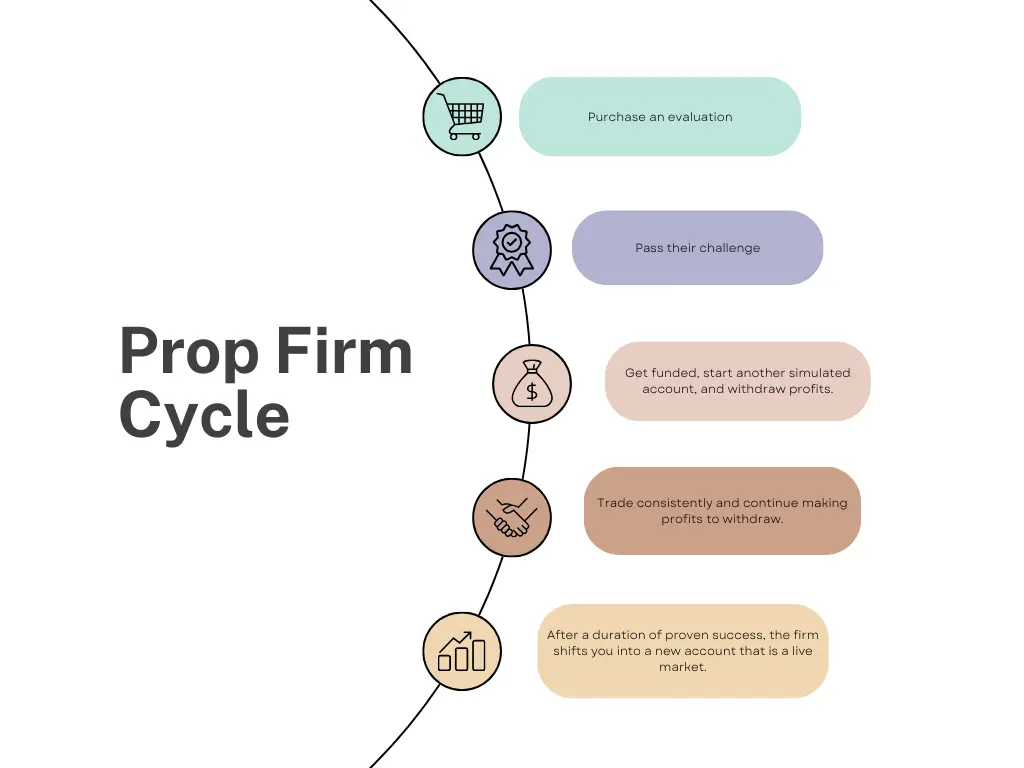
Simulated Evaluation Phase: In this preliminary phase, your trading capabilities is put to the test. A virtual demo account with a predetermined balance is assigned to you, challenging you to reach a specific profit target within the limits of an allowable drawdown, all while adhering to a set of trading rules.
Simulated Funded Phase: At this critical stage, the primary goal is to demonstrate consistent and reliable trading over a set period, in accordance with the payout structure. It’s essential to prove that you can maintain profitability within a simulated environment. Notably, any profits generated during this phase are genuine and can be withdrawn.
Live Funded Phase: Upon reaching this pinnacle, a live trading account is bestowed upon you, indicating a strong confidence in your trading discipline and strategy. This stage immerses you in real-market scenarios where you operate with actual funds. The aim here is to conduct trading with responsibility, achieve tangible profits, and cultivate growth within the account.
End of Day (EOD) Drawdown: This type of drawdown is assessed at the end of the trading day. If a new high in the account balance is achieved at the end of a session, the drawdown limit is adjusted upwards. However, what happens during the day does not affect the drawdown unless it’s violated, leading to account termination. This approach allows traders some flexibility during the trading day, as the drawdown limit only updates based on the end-of-day account balance.
Unrealized Trailing Drawdown: In this type, the drawdown is constantly adjusted based on the highest reached balance, including unrealized profits and losses from open positions. This means if a trader’s open position shows a significant profit, the drawdown limit trails this profit, reducing the amount of drawdown available. This type of drawdown is more challenging as it requires traders to be very mindful of their open positions and the impact they have on the drawdown limit.
Static Drawdown: Static drawdown is the most straightforward and trader-friendly type. In this setup, the drawdown limit does not change regardless of the account balance. It remains fixed, offering a clear and unchanging target for the trader to manage. This type of drawdown is generally preferred by traders because of its simplicity and predictability.